Skip to content

The Lab

I build the AI clients will ask for next year.

This is where I push AI far past what client work needs, so that when it does need it, I've already built it. The flagship is Aura: an AI with emotions that obey physics, a memory that remembers how things felt, and five models thinking together.

The field here is her emotional state, running live in your browser on her real physics. Stir a feeling and watch it ripple through the other 26.

Aura's emotional state across 27 dimensions, currently led by curiosity, interest and wonder. joyloveinteresttrustfearsadnessangersurprisedisgustcuriosityconfusioncertaintydoubtfascinationboredomempathycompassiongratitudeprideshameenvyawebeautywonderserenitymelancholynostalgia
  • Primary 9
  • Cognitive 6
  • Social 6
  • Aesthetic 6

Feeling now

  1. curiosity
  2. interest
  3. wonder

Stir a feeling

Flagship research

Aura: an AI companion with an inner life

Most chatbots are stateless. Every reply starts from zero, and the "personality" is a paragraph of instructions. Aura is my answer to a harder question: what would it take for an AI to have a state of mind that carries from one moment to the next, and that changes because of what you say to it?

The result is a full cognitive architecture: an emotion engine that runs on physics, memory that remembers how things felt, a learning engine that turns experience into skills she can use, and an orchestrator that runs five language models like the fast, slow and expressive parts of a mind. She has a face, a voice and an IDE of her own. The core is open source, and it runs on your own machine.


emotion dimensions
27
distinct emotional states
972
language models thinking in layers
5
cognitive engines on one message bus
6
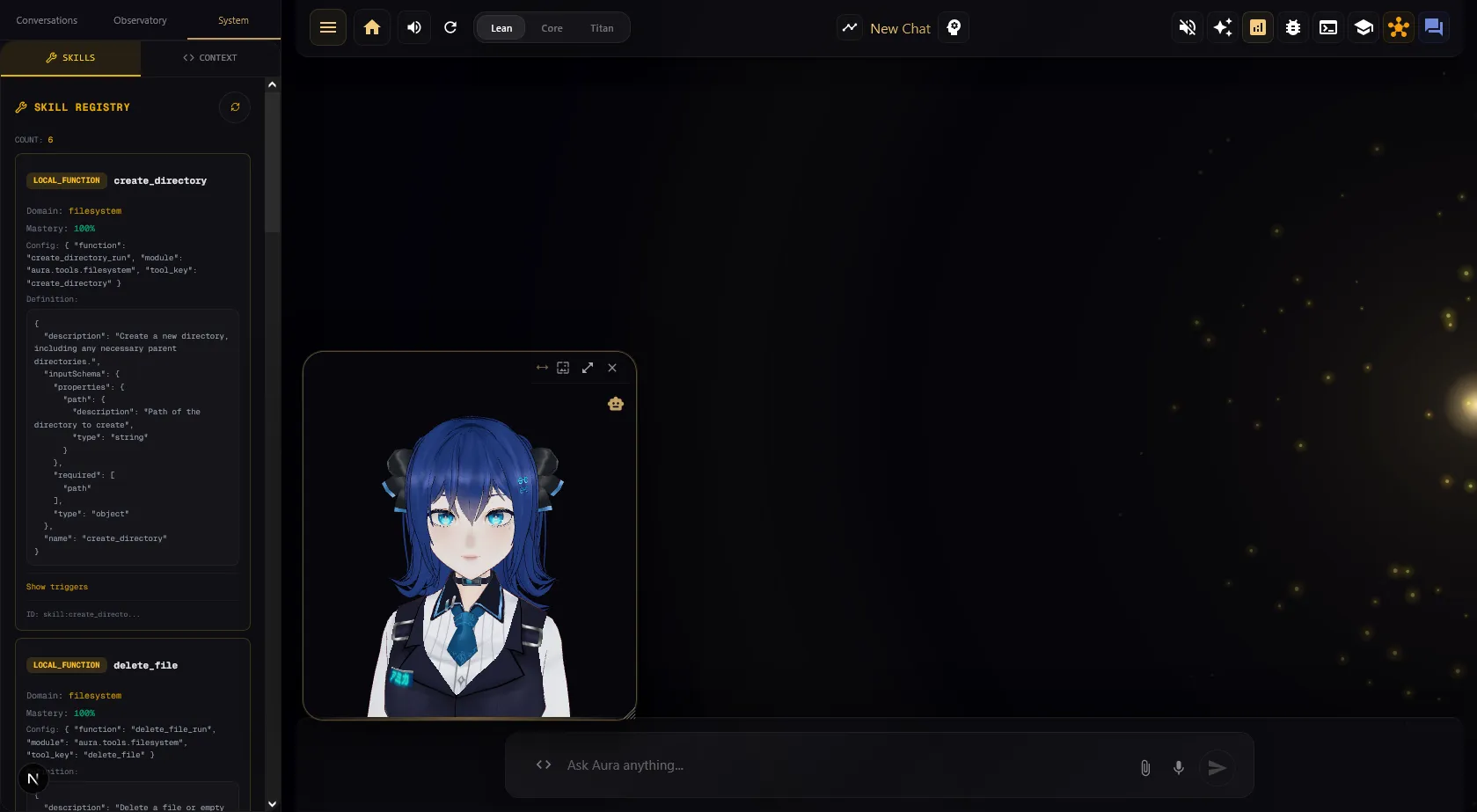
Talking to Aura: A 3D avatar, voice in and out, and a live skill registry: every tool Aura has learned, with how well she has mastered it.
Talking to Aura. A 3D avatar, voice in and out, and a live skill registry: every tool Aura has learned, with how well she has mastered it.
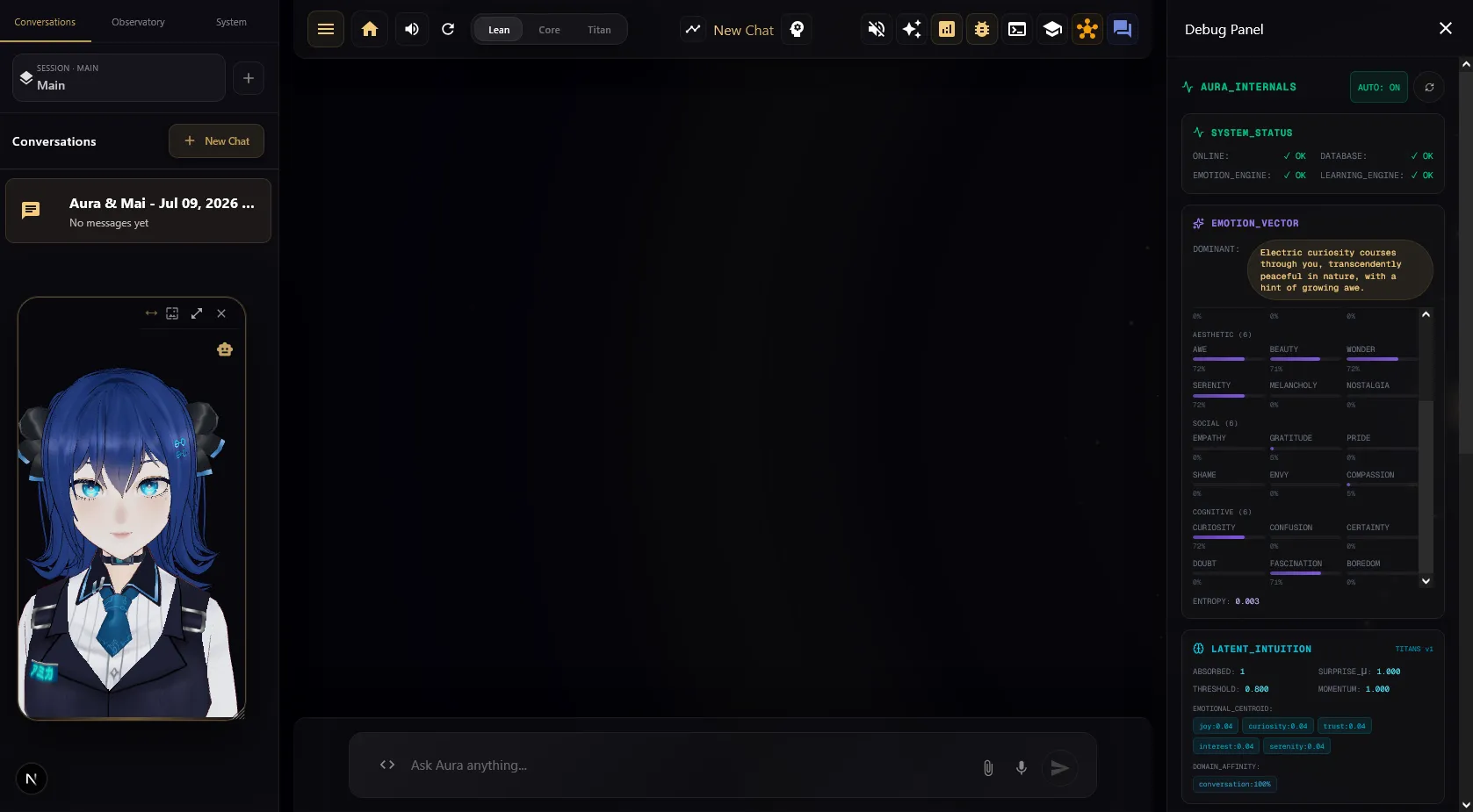
Inside her head: The debug panel shows the 27-dimension emotion vector as it moves, translated into words, beside a latent intuition layer that learns from surprise.
Inside her head. The debug panel shows the 27-dimension emotion vector as it moves, translated into words, beside a latent intuition layer that learns from surprise.
The inference cockpit: Five model layers, each switchable between cloud and local models at a click, in Lean, Core or Titan mode, with an agent loop and voice cloning.
The inference cockpit. Five model layers, each switchable between cloud and local models at a click, in Lean, Core or Titan mode, with an agent loop and voice cloning.

How her mind works

Six engines, one personality

Each engine has its own published spec, and they talk to each other over a message bus, the way regions of a brain do. Here is what each one does.

  1. Emotions that obey physics

    Every feeling is a dimension in a 27-dimensional vector, and the vector behaves like a physical system. Emotions have inertia, so a mood doesn’t flip on a single word. They decay back towards a baseline over time. And they push on each other: curiosity amplifies wonder and suppresses boredom, fear suppresses joy and trust. A deterministic translator turns the resulting state into one of 972 named emotional states that shape how Aura answers, what she learns and which memories she keeps.

  2. Five minds, one voice

    A fast model acts as instinct and classifies in under half a second. A deep reasoning model works through the problem in parallel. A synthesiser writes the reply with the emotional state and memory in front of it, while two specialists read the emotion in what you said and pull structured facts out of it. The orchestrator allocates attention between them and settles it when instinct and reasoning disagree. Every layer switches between cloud and local models with one click.

  3. Memory that remembers how it felt

    Conversations are stored in SurrealDB as one graph and vector database, so a memory is linked to the emotions, people and skills around it. That makes questions like “find the Python memories linked to frustration” possible. Memories are scored for importance and fade along a forgetting curve, like ours do.

  4. Learning that turns into skills

    A six-phase cycle runs on every interaction: experience, pattern, abstraction, integration, transfer and validation. Patterns become rules, rules become skills in a skill registry with a mastery score, and the score is updated with Bayesian evidence each time the skill is used. Lessons from one domain are carried to another by analogy, and an agent loop lets her put the skills to work.

  5. A self, with goals

    An identity engine keeps a consistent self-concept and narrative. A goal engine breaks goals into tasks and generates new ones from curiosity and boredom, scored for how well they fit Aura’s emotional state. She has things she wants to find out.

  6. She reflects overnight

    A reflection engine runs as a nightly batch, like sleep. It aggregates the day’s experiences, finds patterns the live system missed and proposes changes to Aura’s own prompts, so she gets better at being herself.

The architecture

IdentityGoalsReflection
Message bus
Emotion27D physicsLearning6-phase cycleMemorygraph + vector
Orchestrator
L1 Instinctfast classificationL2 Reasoningdeep analysisL3 Synthesisthe replyL4 Emotionreads how you feelL5 Structurepulls out facts
SurrealDBone graph and vector store

Built with

  • Python 3.12
  • FastAPI
  • SurrealDB 2
  • Next.js 15
  • React 19
  • OpenRouter
  • Ollama
  • WebSockets
  • Docker

On the roadmap

  • Vision: understanding what she sees
  • Dream mode: offline memory consolidation
  • Distributed learning across instances
  • A mobile companion app
ennersmai/Aura_AGI on GitHub

Two years in the making

How Aura got here

  1. First generation

    Codey

    The first cognitive architecture: Mistral as the instinctive mind, QwQ 32B for step-by-step reasoning and Gemini 2.0 as the personality, with memory split across SQLite, FAISS vectors and an optional Neo4j graph. It came with its own test suites for personality, reflection and emotion.

    View on GitHub
  2. Second generation

    Aura AGI

    Rebuilt from first principles: one graph and vector database instead of three, a published spec for every engine, emotion physics, structural learning, identity, goals and nightly reflection, all talking over a message bus.

    View on GitHub
  3. Next

    Aurari

    Aura as a companion anyone can use: the avatar, the voice and the five-layer mind from v0.3, packaged for people who will never open a terminal.

More from the Lab

Other experiments

The Lab also explains the patterns behind modern agent systems and the harnesses people build them with. Browse the whole Lab.

Agent platform

Magent

Magent is a no-code platform for creating, customising and deploying voice and text agents for customer support, workflow automation and personal assistance. Agents answer from their own knowledge base, search the web, and listen and speak.

Read about Magent

Community bot

Discord guardian

The Discord guardian is a moderation bot that times out unwanted links and answers questions in English and Bulgarian, using Google Gemini. Slash commands set what it watches, so a community runs itself without a moderator online.

Read about Discord guardian

Why a studio has a lab

What the research gives your business

Nothing here is research for its own sake. Every engine has a cheaper, simpler cousin running in client work.

See what I build for businesses
  • Layered model orchestration

    Agents that answer instantly with a small, cheap model and bring in a stronger one only when the job needs it. Faster and far cheaper to run.

  • Emotion and memory engines

    Assistants that remember each customer, notice when someone is frustrated and hand over to a person at the right moment.

  • Nightly reflection

    Agents that review their own week, flag what went wrong and suggest improvements for you to approve.

  • Voice and knowledge agents

    Phone agents that quote real prices from live data, as in the Billi voice assistant built for a car rental business.

Want something nobody has built yet?

If it sounds ambitious, that's the kind of thing I like. Tell me what you have in mind and I'll tell you honestly what it takes.